What Your 'Healthy' Lunch Is Actually Doing to Your Blood Sugar (And What to Order Instead)
You did everything right. You skipped the burger, passed on the fries, and ordered the grain bowl with roasted veggies and a light vinaigrette. By 2:30 p.m., though, you're staring at your screen with zero focus, raiding the office snack drawer, and wondering why eating "healthy" left you feeling like this.
Here's what's actually happening — and why a good Indian curry might be the most underrated lunch decision you're not making.
The Problem with "Clean" Labels at Popular Chains
American fast-casual lunch spots have gotten very good at marketing. Words like wholesome, fresh, and balanced show up on every menu board, and most of us take them at face value. But flip to the nutritional data — which chains are required to post — and the numbers tell a different story.
Take a standard grain bowl at one of the major burrito-adjacent chains. A base of white rice alone can clock in at 40–50 grams of refined carbohydrates. Add a flour tortilla on the side, corn salsa, and a scoop of seasoned black beans, and you're looking at 80–100 grams of carbs in a single meal — with very little dietary fat or fiber-rich protein to slow down that glucose spike. The result? A sharp blood sugar rise followed by an equally sharp crash, right around the time your afternoon meetings start.
Wraps at deli-style spots aren't much better. A large flour tortilla alone contributes roughly 45–55 grams of carbs before you've added a single filling. "Healthy" soups at chain restaurants often contain modified food starch, corn syrup solids, or maltodextrin as thickeners — ingredients that hit your bloodstream almost as fast as straight sugar.
None of this makes these places evil. But "fresh" doesn't automatically mean metabolically friendly, and that distinction matters a lot if you're trying to stay sharp and energized through a full workday.
What Indian Curries Actually Contain
Indian cuisine is built on a fundamentally different nutritional architecture. Rather than relying on refined grains or processed sauces for flavor, traditional curries get their depth from whole spices, aromatics, legumes, and slow-cooked vegetables. That shift in foundation changes everything from a blood sugar standpoint.
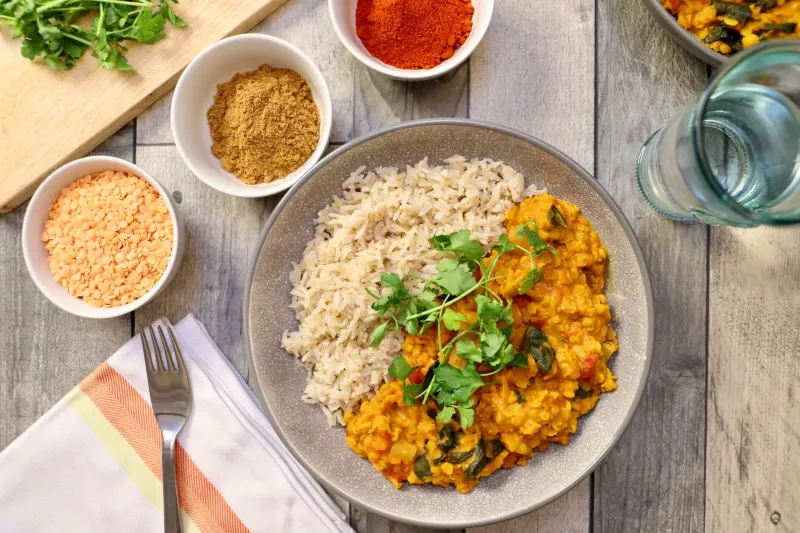
A classic dal — lentil-based curry — delivers around 18 grams of plant protein and 15 grams of fiber per serving. That combination slows glucose absorption dramatically, meaning the energy from your meal enters your bloodstream gradually rather than all at once. A chickpea masala (chana masala) follows a similar pattern: high fiber, moderate protein, and a glycemic index that sits well below what you'd get from a bowl of white rice or a flour-wrapped sandwich.
Even dishes that include rice — like a simple chicken curry served over basmati — benefit from basmati's naturally lower glycemic index compared to standard long-grain white rice. Basmati has a GI of around 50–58, compared to 72 for standard white rice. Pair it with a protein-rich curry and you're looking at a genuinely balanced meal, not just one that sounds balanced on a menu.
The Spice Factor: More Than Just Flavor
Here's where Indian food gets genuinely interesting from a health perspective, and it goes beyond the macros.
The spice blends used in Indian cooking — turmeric, cumin, coriander, fenugreek, ginger — aren't just flavor agents. Each one carries documented metabolic and digestive benefits that most American lunch options simply can't compete with.
Turmeric contains curcumin, a compound with well-researched anti-inflammatory properties. Chronic low-grade inflammation is closely tied to insulin resistance, so regularly consuming turmeric may actually support better blood sugar regulation over time.
Cumin has been shown in multiple studies to support digestive enzyme activity, which helps your gut break down food more efficiently and reduces that heavy, sluggish feeling after eating.
Fenugreek, a common ingredient in many curry bases and spice blends, contains soluble fiber that specifically slows carbohydrate absorption — essentially acting as a built-in blood sugar buffer.
Ginger is a well-known digestive aid that reduces gastric inflammation and supports faster, more comfortable digestion.
When these spices work together in a single dish, the combined effect is a meal that your digestive system processes more smoothly, with fewer energy spikes and a longer window of satiety. No supplement required.
A Side-by-Side Look
Let's make this concrete. Here's a rough nutritional comparison between two popular lunch choices:
Popular Chain Grain Bowl (chicken, white rice, corn, salsa, sour cream)
- Calories: ~800–950
- Carbohydrates: ~90–110g
- Fiber: ~8–10g
- Protein: ~35g
- Notable: High refined carb load, minimal anti-inflammatory compounds
Chicken Tikka Masala with Basmati Rice (standard restaurant portion)
- Calories: ~600–750
- Carbohydrates: ~45–60g
- Fiber: ~6–8g
- Protein: ~38–42g
- Notable: Rich in anti-inflammatory spices, lower glycemic impact, higher satiety per calorie
The tikka masala doesn't just win on carbs — it delivers comparable or better protein while coming in lower on total calories and refined starch. And the spice profile does metabolic work that a grain bowl simply can't replicate.
What to Order When You Want the Energy to Last
If you're ordering from Taaze Express and want a lunch that keeps you focused through the afternoon, here's where to start:
- Dal Tadka or Dal Makhani — lentil-based, high fiber, deeply satisfying without the carb overload
- Chana Masala — chickpeas in a spiced tomato base, one of the best plant-protein lunches you can order
- Chicken or Paneer Tikka Masala — protein-forward, spice-rich, pairs well with a smaller portion of basmati
- Saag Paneer — spinach-based, iron-rich, and genuinely filling without being heavy
- Tandoori Chicken — grilled, lean, and incredibly flavorful without any sauce-based carb additions
If you're watching your carb intake closely, skip the naan and ask for your curry on its own or with a small side of basmati. The flavors are complex enough to stand alone.
The Takeaway
The lunch you've been eating because it sounds healthy might be the reason your afternoons feel like a grind. Indian food — real Indian food, built on whole spices, legumes, and fresh ingredients — isn't just a more exciting option. For a lot of people, it's a genuinely smarter one.
Your blood sugar doesn't care about the menu board's font choices. It cares about what you actually put in your body. And more often than not, a well-made curry is doing a whole lot more for you than that grain bowl ever did.